
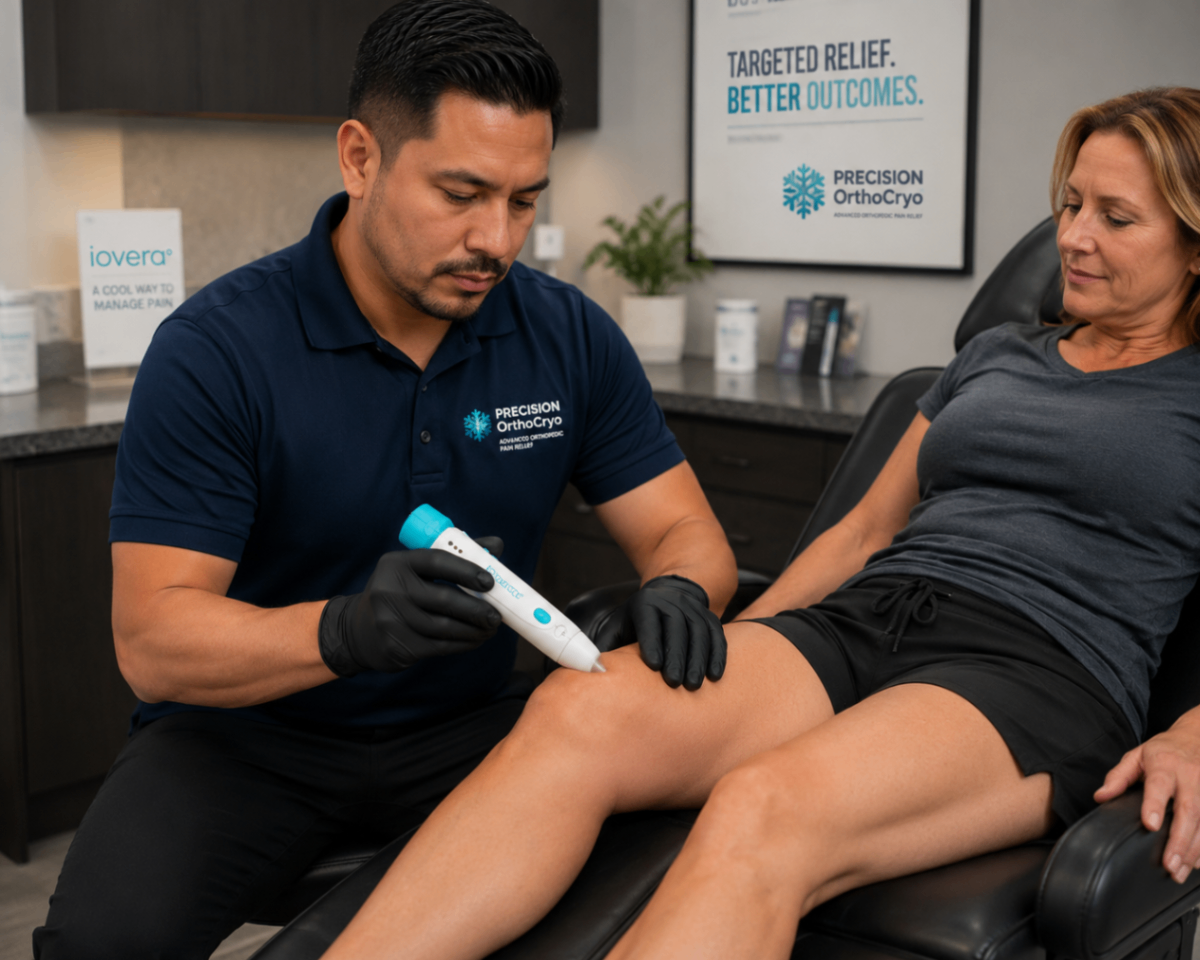
The CJR-X Partner
for Joint Replacement.
CJR-X makes bundled payment accountability mandatory for most U.S. hospitals starting January 2028. Precision OrthoCryo® delivers preoperative pain optimization, outcomes tracking, and a turnkey service line — everything you need to earn shared savings under episode-based care.
Why Hospitals Are Adding
Cryotherapy Now
CJR-X — CMS's proposed mandatory bundled payment expansion beginning January 2028 — makes episode-based accountability the new standard for joint replacement. Hospitals that reduce opioid use, shorten stays, and improve patient satisfaction will earn shared savings. Those that don't will repay Medicare. Cryoneurolysis addresses every driver CJR-X is designed to improve.
Opioid Reduction Mandates
CMS and state regulators are tightening opioid prescribing. Cryoneurolysis delivers 45% opioid reduction — documented, defensible, and drug-free.
CJR-X & CMS Quality Metrics
CJR-X makes bundled payment mandatory in 2028. HCAHPS pain scores, readmission rates, and episode costs all improve with cryoneurolysis — turning compliance into shared savings.
Length of Stay Pressure
0.8-day shorter average LOS per orthopedic patient. At scale, this frees capacity, reduces cost, and improves throughput across your surgical service line.
New Revenue Stream
The hospital captures facility fee revenue on every cryoneurolysis procedure — a high-margin service with no capital investment and no staffing burden.
CJR-X Is Coming.
Is Your Hospital Ready?
CMS's proposed nationwide expansion of bundled payment for joint replacement will make episode-based accountability mandatory for most U.S. acute care hospitals. Precision OrthoCryo is built to help you win under it.
CJR-X (Comprehensive Care for Joint Replacement Expanded) is CMS's proposed nationwide expansion of the original CJR bundled payment model. If finalized, it begins January 1, 2028 and makes bundled payment accountability for joint replacement mandatory for most U.S. acute care hospitals.
Unlike traditional fee-for-service, hospitals are no longer rewarded simply for performing surgery — they are rewarded for delivering an efficient 90-day episode of care.
- Total Knee Arthroplasty (TKA)
- Total Hip Arthroplasty (THA)
- Certain ankle replacements
- Hip fracture replacements
CMS calculates a target price for each 90-day episode — covering the hospital stay, home health, physical therapy, readmissions, ED visits, skilled nursing, and all Medicare spending related to the episode.
Quality also affects whether the hospital earns savings. Hospitals cannot simply reduce spending — they must maintain outcomes and patient experience.
We Address the Episode at Every Phase.
- Decreases arthritis pain
- Improves function & mobility
- Improves sleep quality
- Reduces pre-op opioid use
- Allows patients to strengthen before surgery
- Improves mental readiness
Healthier patients tend to recover faster.
- Patients walk sooner
- Fewer narcotics needed
- Earlier therapy participation
- Shorter hospital stay
These are key goals under episode-based care.
- Fewer ED visits
- Fewer unplanned clinic visits
- Fewer pain-related readmissions
- Better therapy participation
- Higher patient satisfaction
Even modest improvements matter financially at scale.
"CJR-X changes the economics of joint replacement. Hospitals are now responsible for the entire 90-day episode, not just the surgery. Precision OrthoCryo helps hospitals optimize patients before surgery through targeted cryoneurolysis — reducing pain, supporting earlier mobility, lowering opioid requirements, and improving recovery. We provide a turnkey hospital-based program with outcomes tracking designed specifically to help health systems succeed under value-based joint replacement."
- Pain scores (VAS/PROMIS)
- Opioid consumption (MME)
- PACU time
- Length of stay
- Same-day discharge rate
- Home vs. SNF discharge
- Readmissions
- ER utilization
- Patient satisfaction (PROMs)
- Cost per episode
Our outcomes registry captures all of this — ready for your CJR-X reporting.
"The Preoperative Pain Optimization Partner
for Value-Based Joint Replacement."
We're not selling a procedure. We're your hospital's partner for CJR-X success — connecting clinical outcomes to the financial and quality objectives CMS is designed to reward.
Discuss Your CJR-X ReadinessThe Precision OrthoCryo Clinical
Implementation Framework (PCIF)
Technology can improve patient care. Only disciplined implementation can transform healthcare. PCIF is the structured methodology that enables hospitals to deliver exceptional orthopedic pain optimization consistently, safely, and at scale.
The PCIF Flywheel
Every implementation strengthens the next one.
Clinical Excellence
Protocols are evidence-informed, standardized where appropriate, and continuously refined. Patient safety, procedural consistency, and measurable quality are the first priorities.
"Excellence is designed, measured, and continuously improved."
Enterprise value: Quality and trust
Education & Clinical Leadership
Providers progress through anatomy, landmark identification, ultrasound confirmation, procedural refinement, mentorship, case review, and quality feedback.
"The goal is not simply to train providers. The goal is to develop clinical leaders."
Enterprise value: Workforce scalability
Hospital Integration
A structured integration pathway aligned with orthopedic service lines, compliance requirements, scheduling, executive oversight, and value-based care priorities.
"Hospitals adopt systems, not isolated procedures."
Enterprise value: Adoption and sustainability
Outcomes Intelligence
Longitudinal measurement of pain, function, opioid use, mobility, patient satisfaction, complications, and episode performance — aligned with CJR-X quality priorities.
"What is measured can be improved."
Enterprise value: Evidence and accountability
Operational Excellence
Standardized implementation planning, staffing, scheduling, documentation, quality assurance, compliance, and executive reporting. Each deployment makes the next faster and stronger.
"Standardize what should be standard. Customize what creates value."
Enterprise value: Replicability and margin discipline
Continuous Innovation
Future enhancements include improved imaging, artificial intelligence, predictive analytics, patient engagement, registry science, and reimbursement strategy.
"The framework should improve faster than healthcare changes around it."
Enterprise value: Long-term differentiation
Executive Takeaway
The true product is not a procedure. The true product is a repeatable implementation framework.
Precision OrthoCryo is not a collection of services. It is an integrated architecture designed to translate clinical innovation into repeatable hospital capability.
Everything Included.
Nothing Left to Figure Out.
We've built this program to be zero-friction for hospital systems. Your administrators, surgeons, and compliance team will find everything already handled — from staffing to billing to legal documentation.
The Numbers.
Transparent and Compelling.
All projections based on ~2,500 patients annually at a single hospital site. Actual results vary by patient volume and payer mix.
All fees are fixed and fair market value-based. No revenue sharing. No volume-based compensation. Fully compliant with Stark Law and Anti-Kickback Statute.
Move the Metrics That
Drive Reimbursement.
CMS ties a meaningful portion of hospital reimbursement to HCAHPS scores and length-of-stay performance. Cryoneurolysis improves both — simultaneously.
Better Scores. Better Reimbursement.
HCAHPS "Pain Management" domain scores directly affect Hospital Value-Based Purchasing (VBP) reimbursement. Patients who receive iovera° cryotherapy report significantly better pain control — improving your composite HCAHPS score and protecting your VBP adjustment.
0.8 Days Shorter. At Scale, That's Capacity.
Plessl et al. (JAAOS, 2020) documented a statistically significant reduction in average length of stay from 2.5 days to 0.8 days (p<0.0001) in TKA patients who received cryoneurolysis. At 2,500 patients per year, that's 4,250 freed bed-days annually.
One service line. Four CMS metrics. All moving in the right direction.
Built Like Anesthesia.
Compliant by Design.
Our Management Services Organization (MSO) structure mirrors the models hospitals already use for anesthesia groups, emergency medicine, and hospitalist programs — making compliance review straightforward for your legal and administrative teams.
All compensation is fixed and fair market value-based. There is no revenue sharing, no volume-based incentives, and no self-referral arrangement. We provide full documentation for your compliance team from day one.
- MSO Agreement with FMV analysis
- Stark Law exception analysis
- Anti-Kickback Statute safe harbor memo
- Medical director agreement template
- Equipment lease agreement
- Credentialing documentation
Fixed FMV compensation only. No self-referral arrangements. No percentage-based or volume-based payments of any kind.
All compensation structures qualify under established AKS safe harbors. No remuneration tied to referral volume or value.
The same structure used by anesthesia groups, ED physician groups, and hospitalist programs nationwide. Your compliance team will recognize it immediately.
The compliant structure is designed to replicate cleanly across multiple hospital sites within a health system — same documentation, same model.
Live in 60 Days.
Here's How.
Agreement & Compliance Review
Execute MSO agreement. Provide full compliance documentation package to your legal team. Conduct financial model review with administration.
Credentialing & Onboarding
Provider credentialing through your medical staff office. Surgeon onboarding and protocol training. Workflow integration planning.
Equipment & Staff Deployment
iovera° system installation and staff training. Patient education materials deployed. Billing and coding setup completed.
Go Live
First patients treated. Ongoing support from our partnership team. Monthly reporting on outcomes and financial performance.
Ideal Partner Profile
We work best with hospitals that meet these criteria
Orthopedic Volume
500+ total joint replacements annually. Knee, hip, and shoulder procedures. Active orthopedic surgery program.
Engaged Surgeons
Orthopedic surgeons open to enhanced recovery protocols. Interest in opioid reduction and improved patient outcomes.
Growth Mindset
Administration focused on service line development, quality improvement, and competitive differentiation.
Ready to See How You'll Perform
Under CJR-X?
We'll build a custom financial model based on your patient volume, payer mix, and current episode costs. No obligation. Fully confidential.
Real-World iovera° Results
Aggregated from de-identified patient surveys · Updated in real time