
The Science Behind
the Outcomes.
Precision OrthoCryo®'s protocols are grounded in published, peer-reviewed clinical research. The evidence is clear: cryoneurolysis reduces opioid use, shortens hospital stays, and improves functional outcomes — without complications.
Foundational Clinical Research
Seven peer-reviewed publications spanning RCTs, cohort studies, and case reports — covering knee, hip, and shoulder indications.
Administration of Preoperative Cryoneurolysis is Associated with Continued and Persistent Opioid Reduction and Improved Outcomes in Primary Total Knee Arthroplasty
Dasa V, et al. Administration of Preoperative Cryoneurolysis is Associated with Continued and Persistent Opioid Reduction and Improved Outcomes in Primary Total Knee Arthroplasty. J Arthroplasty. 2024.
- Preoperative cryoneurolysis was associated with continued and persistent opioid reduction in patients undergoing primary total knee arthroplasty — extending the benefit beyond the immediate post-operative window.
- Patients who received cryoneurolysis prior to TKA demonstrated improved patient-reported outcomes compared to controls, reinforcing the functional recovery benefits seen in earlier studies.
- The study supports a durable opioid-sparing effect of preoperative cryoneurolysis, with reductions persisting well into the recovery period — a clinically meaningful finding for CJR-X episode cost management.
- No increase in adverse events or complications was observed in the cryoneurolysis group, consistent with the established safety profile across prior TKA and THA studies.
- These findings strengthen the evidence base for preoperative cryoneurolysis as a standard component of multimodal pain management and enhanced recovery protocols in primary TKA.
Cryoneurolysis Is a Safe, Effective Modality to Improve Rehabilitation after Total Knee Arthroplasty
Mihalko WM, et al. Cryoneurolysis Is a Safe, Effective Modality to Improve Rehabilitation after Total Knee Arthroplasty. Life. 2022;12(9):1344. DOI: 10.3390/life12091344
- Patients treated with cryoneurolysis prior to total knee arthroplasty had a mean length of stay of 2.5 days compared to 3.5 days in the control group — a full day reduction.
- Cryoneurolysis was associated with improved rehabilitation trajectories post-TKA, including earlier mobilization and better functional recovery in the acute post-operative period.
- The modality demonstrated a strong safety profile with no statistically significant increase in adverse events, complications, or neurologic sequelae compared to controls.
- Findings reinforce cryoneurolysis as a safe and effective adjunct to multimodal pain management and enhanced recovery after surgery (ERAS) protocols for TKA.
- This study adds to the growing body of peer-reviewed evidence supporting pre-operative cryoneurolysis as a standard-of-care component in orthopedic joint replacement programs.
Percutaneous Cryoneurolysis for Postoperative Pain Control Following Total Knee Arthroplasty: A Pilot Study
Dasa V, et al. Percutaneous cryoneurolysis for postoperative pain control following total knee arthroplasty: a pilot study. Arthroplasty Today. 2021;10:77-82. DOI: 10.1016/j.artd.2021.06.009
- Patients receiving pre-operative percutaneous cryoneurolysis reported lower pain scores at rest and with activity compared to controls through 6 weeks post-TKA.
- Opioid consumption was reduced in the cryoneurolysis group during the postoperative period, supporting its role in multimodal pain management.
- The procedure was well-tolerated with no serious adverse events attributable to cryoneurolysis, confirming its safety profile in a surgical population.
- Functional outcomes including range of motion trended favorably in the treatment group, though the pilot sample size limited statistical power.
- Results support the feasibility of a larger randomized trial and reinforce cryoneurolysis as a promising adjunct to standard TKA recovery protocols.
Cryoneurolysis Before Total Hip Arthroplasty Reduces Inpatient Opioid Consumption and Length of Stay
Plessl D, et al. Cryoneurolysis before total hip arthroplasty in patients with severe osteoarthritis reduces inpatient opioid consumption and length of stay. J Am Acad Orthop Surg. 2020;28(14):e622-e627.
- Pre-operative cryoneurolysis significantly reduced average length of stay from 2.5 days (control) to 1.7 days (treatment) — a 0.8-day reduction with P<0.0001.
- Inpatient opioid consumption was significantly lower in the cryoneurolysis group across all measured time points during hospitalization.
- No statistically significant difference in complication rates including deep vein thrombosis, surgical site infection, or neurologic complications.
- Earlier mobilization was observed in the cryoneurolysis group, consistent with reduced pain burden in the immediate post-operative period.
- The study supports pre-operative cryoneurolysis as a safe, effective component of enhanced recovery after surgery (ERAS) protocols for THA.
Rapid Versus Standard Recovery Protocol Is Associated With Improved Recovery of Range of Motion 12 Weeks After Total Knee Arthroplasty
Plessl D, Salomon B, Haydel A, Leonardi C, Bronstone A, Dasa V. Rapid Versus Standard Recovery Protocol Is Associated With Improved Recovery of Range of Motion 12 Weeks After Total Knee Arthroplasty. J Am Acad Orthop Surg. 2020;28(21):e962-e968. DOI: 10.5435/JAAOS-D-19-00597
- Patients in the Rapid Recovery Protocol (RRP) group had a mean length of stay of 0.8 days versus 2.5 days in the Standard Recovery Protocol (SRP) group.
- RRP was associated with significantly greater knee flexion at 2, 6, and 12 weeks post-TKA compared to SRP.
- A higher probability of attaining flexion ≥120° was observed in RRP patients at both 6 and 12 weeks.
- RRP patients had less severe flexion contracture and a lower probability of flexion contracture ≥10° at all three follow-up time points.
- Findings suggest RRP enables patients to perform a greater variety of activities of daily living during the first 3 postoperative months while reducing healthcare costs.
Percutaneous Freezing of Sensory Nerves Prior to Total Knee Arthroplasty
Dasa V, et al. Percutaneous freezing of sensory nerves prior to total knee arthroplasty. Knee. 2016;23(3):523-528.
- Patients receiving pre-operative cryoneurolysis had a 45% reduction in opioid prescriptions during the 12-week post-TKA follow-up period compared to control.
- KOOS (Knee Injury and Osteoarthritis Outcome Score) functional scores were significantly higher in the cryoneurolysis group at both 6 and 12 weeks post-operatively.
- Pain scores (VAS) were consistently lower in the treatment group throughout the post-operative period.
- No significant difference in adverse events, complications, or neurologic outcomes between treatment and control groups.
- Cryoneurolysis was well-tolerated with no serious procedure-related adverse events reported.
Bilateral Suprascapular Nerve Cryoneurolysis for Pain Associated With Glenohumeral Osteoarthritis: A Case Report
Radnovich R, et al. Bilateral Suprascapular Nerve Cryoneurolysis for Pain Associated With Glenohumeral Osteoarthritis: A Case Report. PM&R. 2023.
- A patient with bilateral glenohumeral osteoarthritis underwent suprascapular nerve cryoneurolysis on both shoulders, demonstrating the feasibility of bilateral treatment in a single patient.
- The case documents clinically meaningful pain relief following cryoneurolysis targeting the suprascapular nerve — the primary sensory nerve of the glenohumeral joint.
- This report extends the evidence base for cryoneurolysis beyond knee and hip indications, establishing a clinical rationale for shoulder applications including pre- and post-operative TSA pain management.
- No adverse events were reported, consistent with the established safety profile of cryoneurolysis across other orthopedic indications.
- As a case report, findings are hypothesis-generating and support the design of larger prospective studies evaluating cryoneurolysis for shoulder osteoarthritis and total shoulder arthroplasty (TSA) populations.
Across seven peer-reviewed publications — spanning RCTs, cohort studies, and case reports — cryoneurolysis consistently demonstrates persistent opioid reduction, improved functional outcomes, shorter length of stay, and a strong safety profile across TKA, THA, and shoulder indications including glenohumeral osteoarthritis.
Evidence Across Every
Outcome That Matters
Measured at 12 weeks post-TKA in the Dasa et al. RCT. Cryoneurolysis patients required significantly fewer opioid prescriptions throughout the critical recovery window — addressing one of the most pressing quality and safety concerns in orthopedic surgery.
Knee Injury and Osteoarthritis Outcome Score (KOOS) was twice as high in cryoneurolysis patients at both 6 and 12 weeks post-TKA. Improved functional scores reflect faster recovery, earlier mobilization, and better patient-reported outcomes.
In the Plessl et al. cohort study of THA patients, average length of stay was reduced from 2.5 days (control) to 1.7 days (cryoneurolysis) — a highly significant reduction (P<0.0001). At scale across 2,500 annual patients, this represents substantial capacity and cost impact.
Both studies found no statistically significant difference in complication rates between cryoneurolysis and control groups. No increase in DVT, surgical site infection, or neurologic complications. Cryoneurolysis is a safe addition to existing surgical protocols.
iovera° System
FDA-Cleared Cryoanalgesia
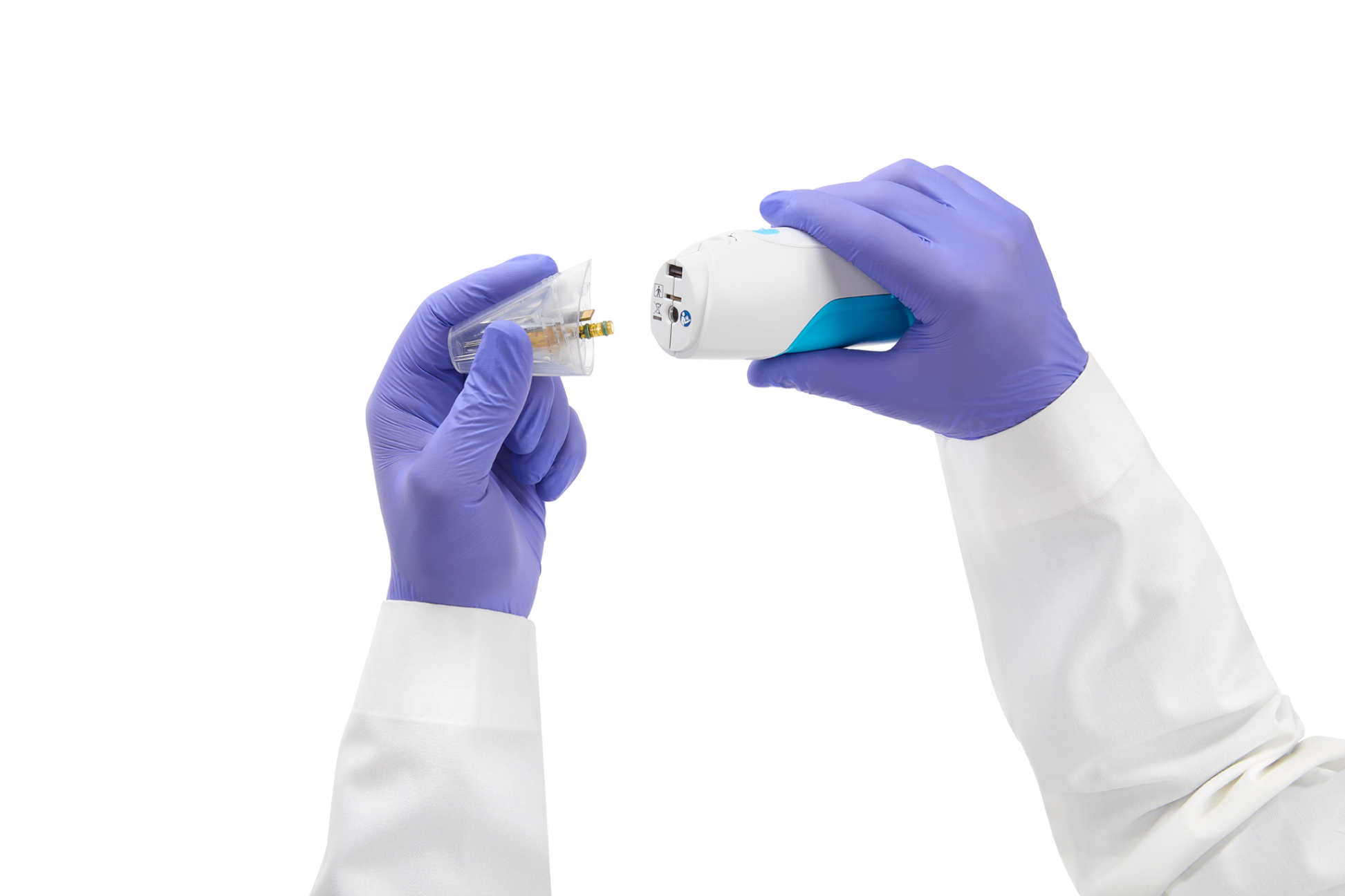
The iovera° system (Zimmer Biomet) is the FDA-cleared handheld device used in all Precision OrthoCryo® protocols. It delivers precisely controlled cold to peripheral nerves using a proprietary needle system — creating a targeted, reversible freeze lesion.
The mechanism is Wallerian degeneration: the axon degenerates distal to the freeze site while the myelin sheath and connective tissue remain intact, allowing full nerve regeneration over 60–90 days. Motor function is preserved throughout because only sensory nerves are targeted.
Complete Outcomes Reference
| Outcome Measure | Result | Significance | Source |
|---|---|---|---|
| Persistent Opioid Reduction (Primary TKA) | Continued reduction post-discharge | Significant | Dasa et al., 2024 |
| Patient-Reported Outcomes (Primary TKA) | Improved vs. control | Significant | Dasa et al., 2024 |
| Length of Stay Reduction (TKA) | 1.0 day shorter (3.5 → 2.5) | Significant | Mihalko et al., 2022 |
| Rehabilitation Outcomes (TKA) | Improved vs. control | Significant | Mihalko et al., 2022 |
| Average Length of Stay (THA) | 0.8 days shorter (2.5 → 1.7) | P<0.0001 | Plessl et al., 2020 |
| Inpatient Opioid Consumption | Significantly reduced | P<0.05 | Plessl et al., 2020 |
| DVT Rate | No difference | NS | Plessl et al., 2020 |
| Surgical Site Infection | No difference | NS | Plessl et al., 2020 |
| Neurologic Complications | No difference | NS | Multiple studies |
| Adverse Events (procedure-related) | None reported | N/A | Multiple studies |
| Opioid Prescription Reduction (12 wks) | 45% reduction | P<0.05 | Dasa et al., 2016 |
| KOOS Functional Score (Wk 6) | 2X improvement | P<0.05 | Dasa et al., 2016 |
| KOOS Functional Score (Wk 12) | 2X improvement | P<0.05 | Dasa et al., 2016 |
| VAS Pain Score (Post-op) | Significantly lower | P<0.05 | Dasa et al., 2016 |
NS = Not Statistically Significant. All data from published, peer-reviewed studies. Dasa V, et al. Knee. 2016;23(3):523-528. Plessl D, et al. J Am Acad Orthop Surg. 2020;28(14):e622-e627. Mihalko WM, et al. Life. 2022;12(9):1344. Dasa V, et al. J Arthroplasty. 2024. Individual patient results may vary.
The clinical data presented on this page is sourced from published, peer-reviewed studies and is provided for informational purposes for healthcare professionals and institutional partners. This information does not constitute medical advice and should not be used as the sole basis for clinical decision-making. Individual patient outcomes may vary. All procedures should be performed by qualified, credentialed providers following established clinical protocols. Precision OrthoCryo® does not manufacture the iovera° device; iovera° is a registered trademark of Pacira BioSciences, Inc. (now Zimmer Biomet).
Real-World iovera° Results
Aggregated from de-identified patient surveys · Updated in real time
Ready to Bring This Evidence
to Your Patients?
Schedule a consultation to see how these outcomes translate to your facility's patient population and financial performance.